
Which Are the Top Water Charities in Pakistan?
The trusted water donation charities in Pakistan are those that combine transparency, long-term water solutions, and measurable impact in high-need areas.
But here’s the reality most people ignore. Not all charities deliver the same level of impact. Some provide temporary solutions, while others create long-term access to clean water for entire communities. That’s why choosing the right charity is not just about donating. It is about solving a real and growing crisis.
- Why Water Charity Is One of the Best Sadaqah in Muharram
- This Muharram, Help Villages Still Struggling for Pure Water
- Donate a Hand Pump in Memory of Loved Ones This Muharram
- This Muharram, Donate Water and Earn Lasting Sadaqah Jariyah
- Why Community Water Projects Matter More Than Temporary Aid
- How Sustainable Water Infrastructure Helps Rural Pakistan
Why Water Charity Matters in Pakistan
Pakistan is facing a serious water crisis that directly affects health, daily life, and survival.
- Around 16 million people in Pakistan lack access to clean water near their homes.
- Only about 47% of the population has access to safe drinking water
- Nearly 70% of households consume contaminated water
- Poor water quality contributes to 30–40% of diseases and deaths
These are not minor issues. They show that water scarcity and contamination are nationwide problems affecting millions. In fact, Pakistan is moving from being a water-stressed country to a water-scarce country, meaning the situation is worsening over time.
What This Means for Your Donation
When you donate to a water charity in Pakistan, you are not just helping.
- Providing access to safe drinking water
- Reducing disease and health risks
- Supporting families in daily survival
- Creating long-term impact for communities
This is why water charity is considered one of the most high-impact and essential forms of donation.
What Makes a “Trusted” Water Charity? (Before We Compare)
Before looking at different charities, it is important to understand how to evaluate them properly. Most people choose based on popularity or brand name. That is a mistake. A trusted water charity should be judged based on four key factors.
1. Transparency and Verification
A reliable charity should show exactly what happens after your donation.
- Can you track your donation?
- Do you have any real updates, images, or reports?
- Can you verify project completion?
Without transparency, impact cannot be confirmed.
2. Impact Scale
The value of charity depends on how many people benefit.
- Individual-level projects → limited impact
- Community-level projects → multiplied impact
The best charities focus on serving multiple families or communities.
3. Project Types
Different charities offer different solutions:
- Hand pumps
- Community water systems
- Solar-powered systems
- Water filtration plants
More variety means better alignment with different needs.
4. Accessibility (Cost vs Impact)
A strong charity should allow:
- Small contributions (entry-level donors)
- Medium and large-scale sponsorships
- Scalable impact options
This ensures everyone can participate, regardless of budget.
Top Water Charities in Pakistan (Detailed Comparison)
Now that you understand what defines a trusted charity, let’s break down the major water charities in Pakistan using real factors: transparency, cost, project type, and impact.
Muavin Welfare Foundation (Structured & Transparent Model)
Muavin is positioned differently from most charities because it focuses on full transparency and donor visibility, not just project execution.
Strengths
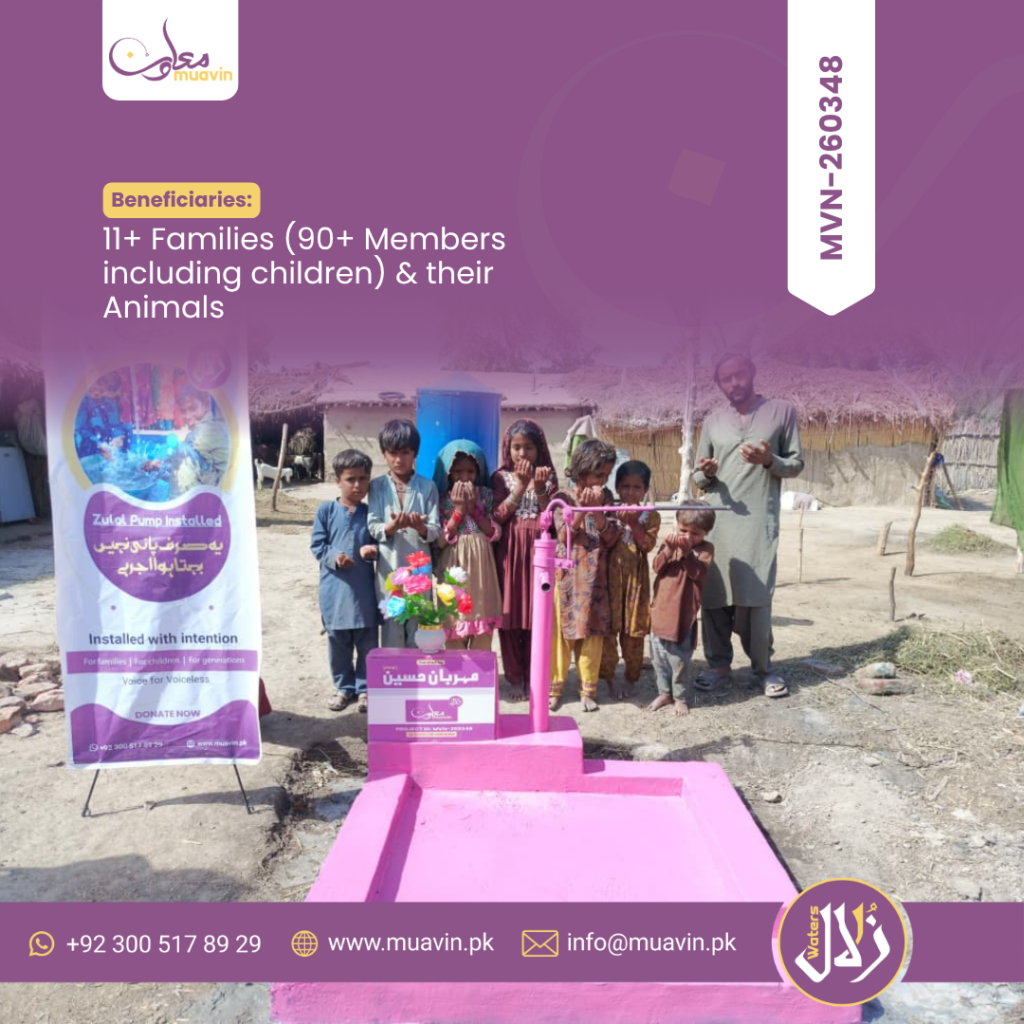
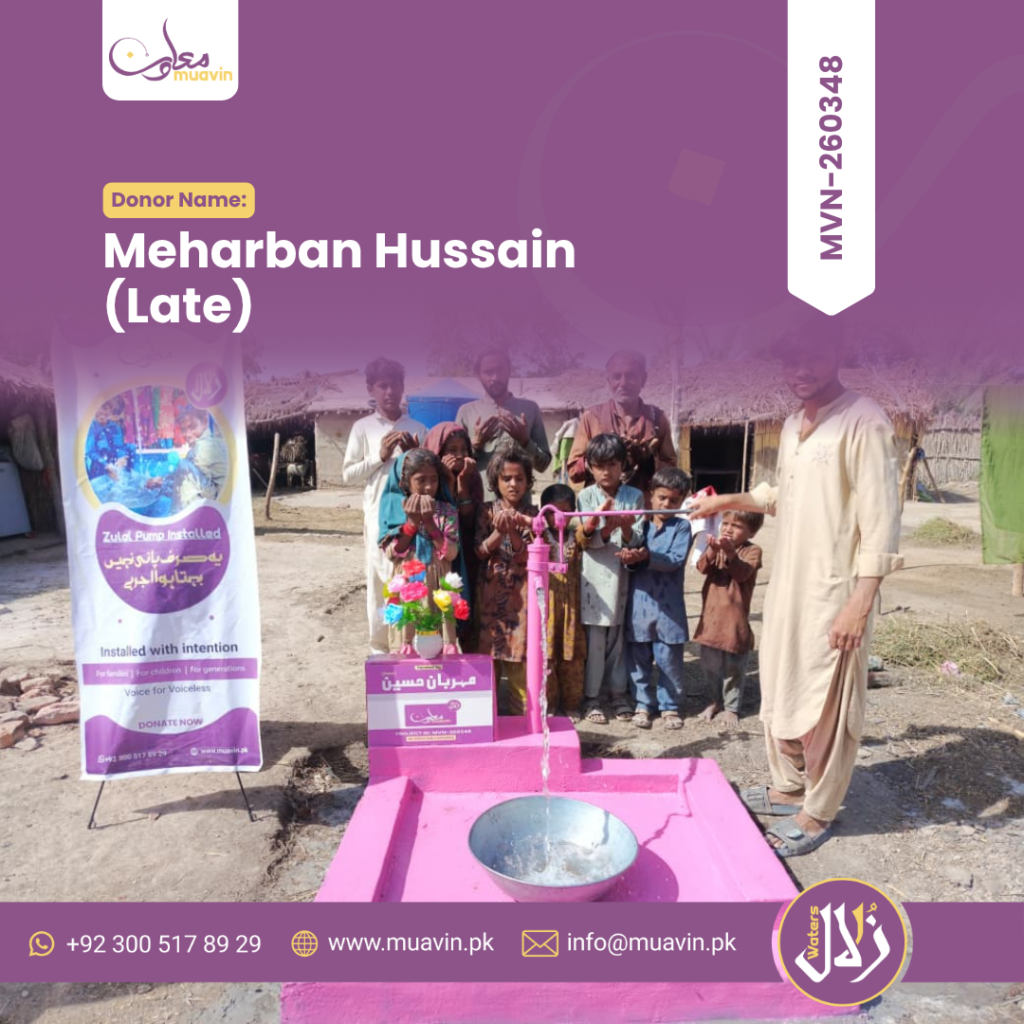
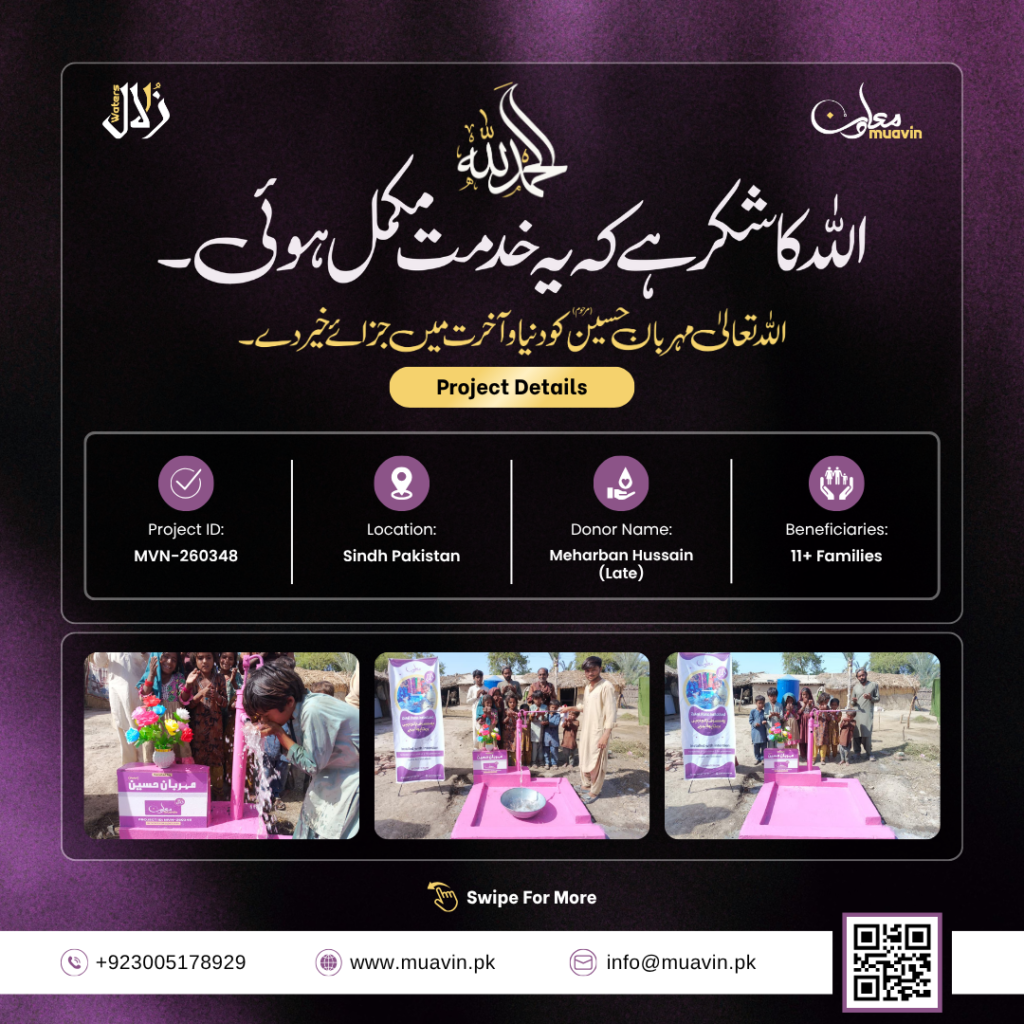
- Full tracking system from donation to completion
- Step-by-step updates with images, videos, and beneficiary details
- Affordable entry point (starting from PKR 5,000)
- Works in high-need areas like rural Punjab and interior Sindh
- Donor name placement and personalized reporting
Best suited for donors who want:
- Verified impact
- Continuous updates
- Control and visibility over their donation
Alkhidmat Foundation
Alkhidmat is one of the largest welfare organizations in Pakistan, focusing on large-scale water infrastructure projects.
Strengths
- Nationwide operations
- Advanced systems like filtration plants and gravity flow schemes
- Strong institutional presence
Limitations
- High cost (projects can reach PKR 2.5 million)
- Limited donor-level tracking compared to smaller systems
Best suited for:
- Large donors
- Corporate or institutional charity
Quba Foundation (Mid to High-Level Projects)
Quba Foundation offers a wide range of water solutions, including hand pumps and solar-based systems.
Strengths
- Variety of project types
- International donor network
- Medium to high-level project options
Limitations
- Higher entry cost for impactful projects
- Limited real-time transparency
Best for:
- Donors with moderate to high budgets
- Those looking for a structured international charity
SKT Welfare (Simple Water Charity Model)
SKT Welfare focuses on basic water pump projects, often targeting underserved communities.
Strengths
- Simple donation process
- Affordable options
- Established charity network
Limitations
- Limited detailed tracking
- Less transparency compared to structured platforms
Best for:
- Simple, quick donations
- Donors are not focused on tracking
Paani Project (Global NGO Model)
Paani Project is an internationally recognized organization working on water access, supported by a global donor base.
Strengths
- Strong documentation and storytelling
- Proven project delivery
- International credibility
Limitations
- Pricing in USD
- Less accessibility for local donors
- Limited personalization
Best for:
- International donors
- Those looking for globally recognized NGOs
Green Trust / Hands Giving (Entry-Level Options)
These organizations focus on basic water pump donations, usually with simple project structures.
Strengths
- Easy entry-level donations
- Simple project types
Limitations
- Minimal transparency systems
- Limited long-term reporting
- Smaller operational scale
Best for:
- First-time donors
- Budget-based contributions
Data-Based Comparison (What Actually Matters)
| Charity | Transparency | Starting Cost | Project Types | Accessibility | Best For |
| Muavin | High | Low | Pumps, Solar, Wazu | High | All donors |
| Alkhidmat | Medium | High | Large systems | Low | Institutions |
| Quba | Medium | Medium-high | Pumps + Solar | Medium | Mid donors |
| SKT | Medium | Medium | Basic pumps | Medium | Simple donors |
| Paani | Medium-high | Medium-high | Wells | Low | Global donors |
| Others | Low | Low | Basic pumps | High | Entry donors |
Each charity operates at a different level, but one pattern is clear:
- Large NGOs focus on scale but have higher cost barriers
- Smaller charities offer accessibility but limited transparency
- Structured systems (like Muavin) combine accessibility + transparency + impact tracking
Which Water Charity Is Best for You?
Now that you’ve seen the comparison, the real question is:
Which water charity should you choose? Because the “best charity” is not universal. It depends on your goal, budget, and level of involvement.
Step 1: Define Your Goal Before Donating
Most people skip this step, and that’s why they choose randomly. Instead, decide first:
If your goal is maximum transparency
You want to:
- Track your donation
- See updates
- Verify completion
Best fit: Structured platforms with full tracking systems
If your goal is large-scale impact
You want to:
- Support big infrastructure
- Fund long-term systems
Best fit: Large NGOs working on filtration plants and major systems
If your goal is affordability + participation
You want to:
- Start with a small amount
- Still contribute to long-term impact
Best fit: Charities with share-based or entry-level options
If your goal is global recognition
You want:
- International NGO credibility
- Well-documented global projects
Best fit: Global NGOs with international donor networks
Step 2: Match Your Goal with the Right Type of Charity
Here’s a simplified decision map based on the comparison:
| Your Priority | Best Type of Charity |
| Full transparency + tracking | Structured platforms (e.g., Muavin model) |
| Large infrastructure impact | Large NGOs (e.g., Alkhidmat) |
| Mid-level structured donation | Quba / SKT |
| Global NGO | Paani Project |
| Simple entry-level giving | Smaller pump charities |
Step 3: Understand Trade-Offs (This Is Where People Fail)
Every charity model has strengths and weaknesses.
Large NGOs
- Strong infrastructure
- But higher cost and less personal tracking
Small NGOs
- Easy to donate
- But limited transparency
Structured platforms
- High transparency
- Balanced cost + impact
“You are not choosing the biggest charity, you are choosing the most effective system for your intention.”
Step 4: Where Most Donors Make Mistakes
Avoid these common errors:
- Choosing based only on brand name
- Ignoring whether projects are verified
- Not checking if updates are provided
- Assuming all charities deliver equal impact
These mistakes reduce the effectiveness of your donation.
Step 5: A Simple Decision Formula
Use this formula before donating:
Impact = (Transparency + Usage Frequency + Number of Beneficiaries)
If a charity scores high on all three, it is a strong choice.
Common Mistakes to Avoid When Choosing a Water Charity
At this stage, most people already have enough information to make a choice. But this is exactly where bad decisions happen. Because even with good intentions, many donors unknowingly reduce the impact of their charity.
Mistake 1: Choosing Based on Popularity Only
Many donors assume:
- Big name = better impact
This is not always true. Large organizations often focus on scale, but may not provide:
- Detailed updates
- Individual project tracking
- Clear proof of completion
Popularity does not guarantee transparency or effectiveness.
Mistake 2: Ignoring Transparency
This is the biggest mistake. If you cannot verify:
- Where your money went
- What was built
- Who benefited
Then your donation becomes uncertain. This matters even more in Pakistan, where:
- Around 70% of households still consume contaminated water
Mistake 3: Focusing Only on Project Cost
Many donors compare:
- Cheapest hand pump
- Lowest contribution
But ignore:
- Project quality
- Sustainability
- Number of beneficiaries
A cheaper, low-impact project is less valuable than a slightly higher-cost project with long-term benefits.
Mistake 4: Not Understanding Project Type
Not all water projects are equal.
- Hand pump → basic access
- Community system → multiple families
- Solar system → long-term sustainability
If you don’t understand this, you may choose a project that doesn’t align with your intention.
Mistake 5: Not Considering Location
Impact depends heavily on where the project is implemented.
In Pakistan:
- Over 10 million people still lack safe water in flood-affected areas
- Around 21 million people lack access to clean water near their homes
A project in a high-need area creates far greater impact than one in a moderate-need area.
FAQs: Best Water Donation Charities in Pakistan
How do I know which water charity in Pakistan is trustworthy?
A trustworthy charity provides transparency, clear project details, and verifiable results. Look for platforms that share updates, beneficiary information, and proof of completion rather than just collecting donations.
What makes one water charity better than another?
The difference comes down to four factors: transparency, project impact, sustainability, and accessibility. A strong charity offers long-term water solutions, serves multiple people, and allows you to verify your donation.
Is donating to large NGOs always better?
Not necessarily. Large NGOs often handle large-scale projects but may lack detailed tracking for individual donors. Smaller or structured platforms may provide greater transparency and clearer visibility into direct impact.
Which charity is best for small donations?
Charities that offer share-based or entry-level contributions are best for small donors. These allow you to participate in long-term projects without needing a large budget.
Which charity is best for large-scale impact?
Organizations that build filtration plants, solar systems, or community water infrastructure are better suited for large-scale impact. These projects serve entire communities and operate over the long term.
Can I track my water donation after giving?
Yes, but only if the charity offers a transparent system. Some platforms provide:
- Project updates
- Images and videos
- Beneficiary location details
- Completion reports
Donate Now
What type of water project creates the most impact?
Projects with daily usage and community-level benefit create the most impact. These include:
- Community water pumps
- Solar-powered systems
- Water filtration setups
These solutions provide long-term access rather than short-term relief.
Does location affect the impact of charity?
Yes, significantly. Water projects in high-need areas such as rural Punjab, Muzaffargarh, and interior Sindh have a much greater impact because they solve urgent and ongoing problems.
What is the biggest mistake people make when donating?
The biggest mistake is donating without verifying the outcome. Many donors focus on brand or price instead of checking whether the project is completed and actually benefiting people.