Water Insecurity in Rural Pakistan
Across Pakistan’s rural heartlands, access to safe, reliable drinking water is not a convenience. It’s a daily struggle to shape life, health, and opportunity. An estimated 21 million Pakistanis currently lack safe drinking water, and the consequences ripple through families, schools, and entire communities. For donors searching for meaningful Sadqa Jariya, a practical and lasting response is to donate to water hand pump projects in Pakistan that restore dignity and safeguard lives.
A national emergency of water insecurity
Rural Pakistan faces a layered crisis. In many villages, piped systems are absent, and agricultural runoff, industrial discharges, and inadequate sanitation contaminate surface water. Groundwater often seems like the only option, yet aquifer depletion and shallow contamination make even wells risky without proper siting and testing.
Key realities:
- One hand pump serves 50–200 people daily, becoming the focal point of village life.
- Waterborne diseases remain a major cause of childhood illness in rural areas.
- Women and children commonly spend hours collecting water each day, reducing time for education, income, and rest.
These conditions turn water into a barrier to development rather than a basic service. Understanding the problem requires both the big-picture numbers and the lived experiences of households fetching buckets before dawn.
Groundwater access and its limits
Groundwater access in Pakistan reflects a complex set of technical and social factors. In many rural communities, villagers rely on shallow tube wells and dug wells that tap local aquifers. Where geology is favorable, these sources can provide safe, clean water for generations. But in large parts of Pakistan, the groundwater is:
- Contaminated with biological pathogens from nearby latrines and livestock
- High in salt or fluoride, causing long-term health risks
- Falling in depth as aquifers are over-extracted, increasing the cost and difficulty of drilling
A simple hand pump, properly sited and installed, can bridge the gap between unsafe surface water and deep community and a community’s means. That is why initiatives that encourage people to donate to a water pump in Pakistan programs can have a significant impact when combined with hydrogeological assessment and community ownership.
Health, time, and dignity
The shortage of safe water is not an abstract statistic; it is a cause of daily hardship. Waterborne illnesses disproportionately affect children — diarrheal disease and parasitic infections remain leading contributors to child morbidity in rural districts. The lack of local safe water also forces families to make trade-offs:
- Parents keep sick children at home because the trip to a clinic is tied to time-consuming water collection.
- Girls miss school to fetch water, reinforcing gender gaps in education.
- Households spend scarce income buying water from vendors when local sources are contaminated.
These consequences illustrate why Islamic charity water projects, especially Sadqa Jariya water pump initiatives, resonate so strongly with donors: they combine faith-based values with measurable humanitarian benefit.
Why Donate a Water Hand Pump
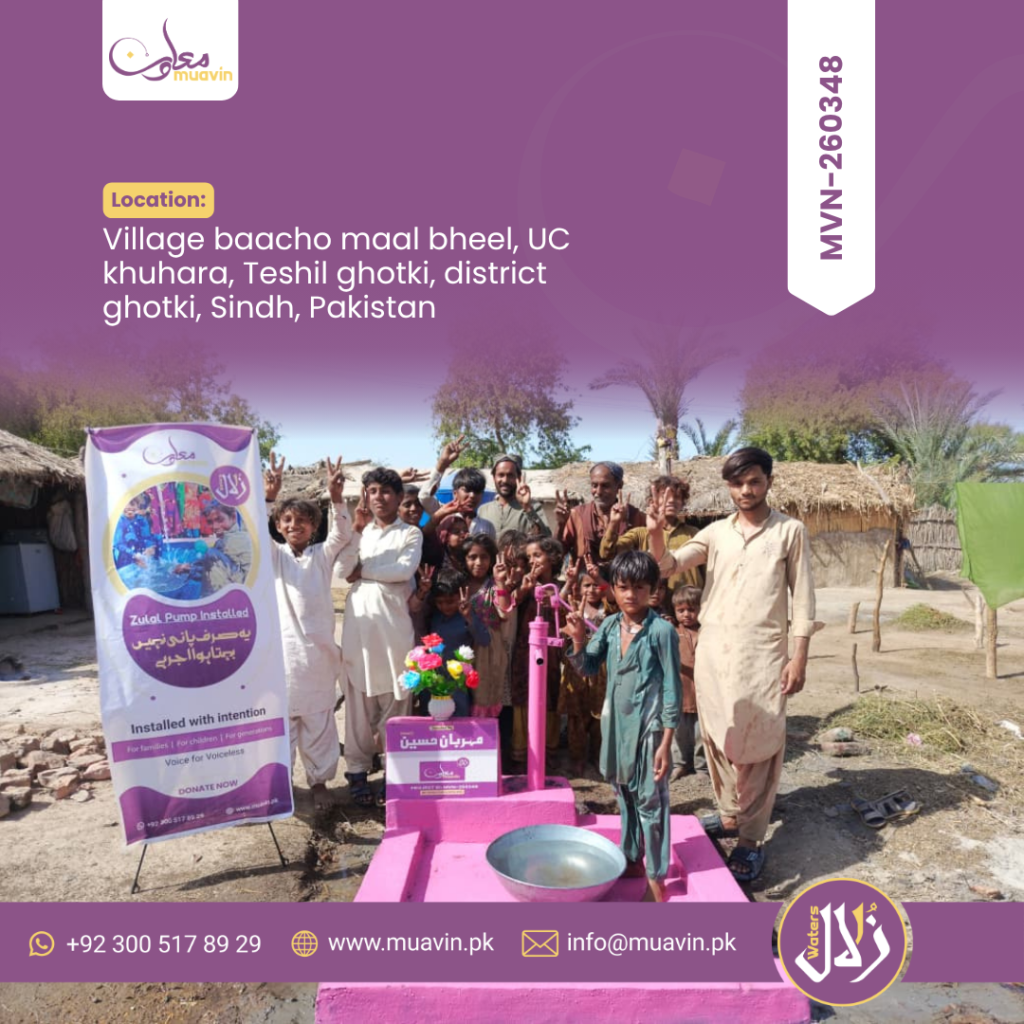
For many Muslim donors, giving is both an act of compassion and a spiritual practice. Sadqa Jariya is a continuing charity that refers to gifts whose giver endures long after the giver’s lifetime. Donating a water hand pump is an accessible form of Sadqa Jariya because a single, well-maintained pump provides ongoing health, time savings, and dignity to dozens or even hundreds of people each day.
Sadqa Jariya
Sadqa Jariya is not only a theological concept but also a practical guideline for durable impact. The difference between a one-off gift and Sadqa Jariya is sustainability: the gift should keep on giving. A hand pump becomes Sadqa Jariya when:
- It consistently supplies clean water to a community.
- Local people are trained to maintain and repair it.
- The site is chosen based on water quality testing and community needs
This approach links Islamic charity water principles with best practices in community water infrastructure in Pakistan, producing outcomes that are both spiritually meaningful and technically sound.
How a hand pump helps
A hand pump’s contribution can be measured across several dimensions: health outcomes, time saved, economic opportunity, and social equity.
| Impact | Before Pump | After Pump |
|---|---|---|
| Daily users served | 0–1 unsafe sources | 50–200 people |
| Waterborne illness | High | Reduced |
| Time collecting water | Several hours | Minutes |
| Girls school attendance | Often missed | Improved |
Immediate community benefits of one hand pump
- Clean, onsite water reduces diarrheal illness and other waterborne conditions.
- Time saved from water collection frees girls for school and women for income-generating work.
- Reduced household spending on purchased water and medical care.
- A visible public asset that strengthens communal pride and social cohesion.
- An enduring form of Sadqa Jariya that benefits generations.
How Hand Pump Projects Work
A hand pump project is simple in concept but requires disciplined technical, social, and managerial processes to deliver lasting results. At its core, the intervention links safe groundwater access, community ownership, and nonprofit support to convert a technical installation into a sustainable service.
Successful installations rest on three technical pillars:
- Hydrogeological assessment: locating a productive, uncontaminated aquifer is the first step. Groundwater access in Pakistan varies by region; careful siting reduces the risk of saline or pathogenic contamination.
- Construction and pump choice: Pumps are drilled or dug to the appropriate depth, cased, and grouted. The selected hand pump must match depth, yield, and user needs.
- Water quality assurance: Microbiological and chemical testing before and after installation confirms the source is safe for drinking, and informs of any necessary treatment or mitigation.
Community engagement and ownership
Technical work alone does not produce Sadqa Jariya. Nonprofit initiatives build community capacity so the pump continues to serve long after installation.
Key elements:
- Community visit to verify need, select the pump site, and agree on rules for use.
- Formation of a local water committee with representation of women and marginalized groups.
- Training on routine maintenance, simple repair, and basic bookkeeping for spare part funds.
- Establishing a small, locally managed savings mechanism for parts replacement (not a large fee burden).
This combination of technical rigour plus community management helps turn an installation into a resilient community water service.
How Communities Receive Support
For rural communities grappling with the water crisis, support usually arrives through a sequence of coordinated steps led by NGOs, local partners, and community leaders.
Needs assessment and site selection
Before any drilling, teams visit & conduct:
- A household- and school-level needs survey to document access gaps.
- Hydrogeological reconnaissance and borehole testing to predict yield and quality.
- Community consultations to confirm priorities and identify a secure, accessible pump location.
These assessments ensure that scarce resources focus on villages where a hand pump will deliver measurable health and social returns.
Installation and handover
Installation follows a clear workflow:
| The on-ground team maintains each hand pump for up to 10 years | Action |
|---|---|
| 1 | Mobilize local contractors and materials after community approval. |
| 2 | Drill the bore and install casing, sanitary seals, and the pump. |
| 3 | Perform immediate water quality testing |
| 4 | Onground team maintain each hand pump up to 10 years |
This staged approach helps minimize the chance of failure and builds local confidence.
Community support services provided by nonprofits
- Technical surveys and drilling supervision
- Water quality testing and post-installation monitoring
- Governance training and formation of a water committee
- Spare-part sourcing and repair toolkits
- Education on hygiene and safe water handling
Many donors choose to donate a water hand pump in Pakistan through vetted partners who combine these services with local accountability.
Spare Parts and Maintenance
A dependable supply chain for spare parts and routine consumables is the backbone that keeps hand pumps working year after year. In rural Pakistan, parts availability, transport reliability, and local technical capacity determine whether a pump is an enduring Sadqa Jariya or a short-lived asset.
Maintenance economics and longevity
- A single hand pump typically serves 50–200 people daily, but small failures, if not fixed promptly, can interrupt water access for an entire community.
- Routine preventive maintenance (greasing, tightening, seal checks) keeps parts’ life high and reduces the frequency of major repairs.
- NGOs work with communities to establish a small, transparent spare-parts fund and simple bookkeeping, so money is available when parts are needed.
Donate to the Hand Pump
Sadqa Jariya water pump program operates in practical terms, from who benefits to how donors can give, whether from Pakistan, the UK, or the USA. The focus is on transparency, including eligibility, costs, oversight, and how communities sustain pumps long-term.
A Sadqa Jariya water pump is a community hand pump installed as a perpetual charitable act, a physical infrastructure gift that provides clean water continuously to people in rural Pakistan. It combines:
- Technical installation (drilling, casing, pump fitting, water testing)
- Community governance (water committees and maintenance training)
- Ongoing support (spare-part supply lines and periodic monitoring)
The concept is rooted in Islamic charity water traditions by providing a lasting service through a water hand pump to benefit generations, while using modern humanitarian standards for construction, testing, and community engagement.
How many people use one pump?
Design and site selection determine user numbers, but typical ranges are:
- Village single pump: 50–200 people daily
- School or small hospital/masjid pump: 100–300 episodic users per day, accordingly.
These figures reflect common patterns across rural Pakistan where one functional water point frequently becomes the hub for nearby households, schools, masjid, and small institutions.
How long does a hand pump last?
Expected lifetimes vary with model, geology, and maintenance:
- Typical functional life with proper maintenance: 10–15+ years
- Major rebuilds or component replacements: Every 5–10 years, depending on water pump base, corrosion, and use intensity.
Life is maximized by:
- Correct pump choice for groundwater depth and chemistry
- Regular preventive maintenance and stocked spare parts
- Community accountability and clear governance
Note: Our on-ground team ensures each hand pump is maintained every month and flowing water continuously for up to 10 years without any disturbance, and the team replaces damaged parts quickly through maintenance funds.
Typical pump longevity factors
| Factor | Effect on lifespan |
|---|---|
| Pump model and materials | High-quality materials extend life |
| Groundwater chemistry (salinity, iron) | Aggressive chemistry accelerates wear unless mitigated |
| Depth to water base | Deeper installations increase stress on rods and seals |
| Community maintenance practices | Regular care dramatically extends operational life |
| Local supply-chain strength | Quick parts access reduces downtime and failure risk |
Can I donate a pump in someone’s name?
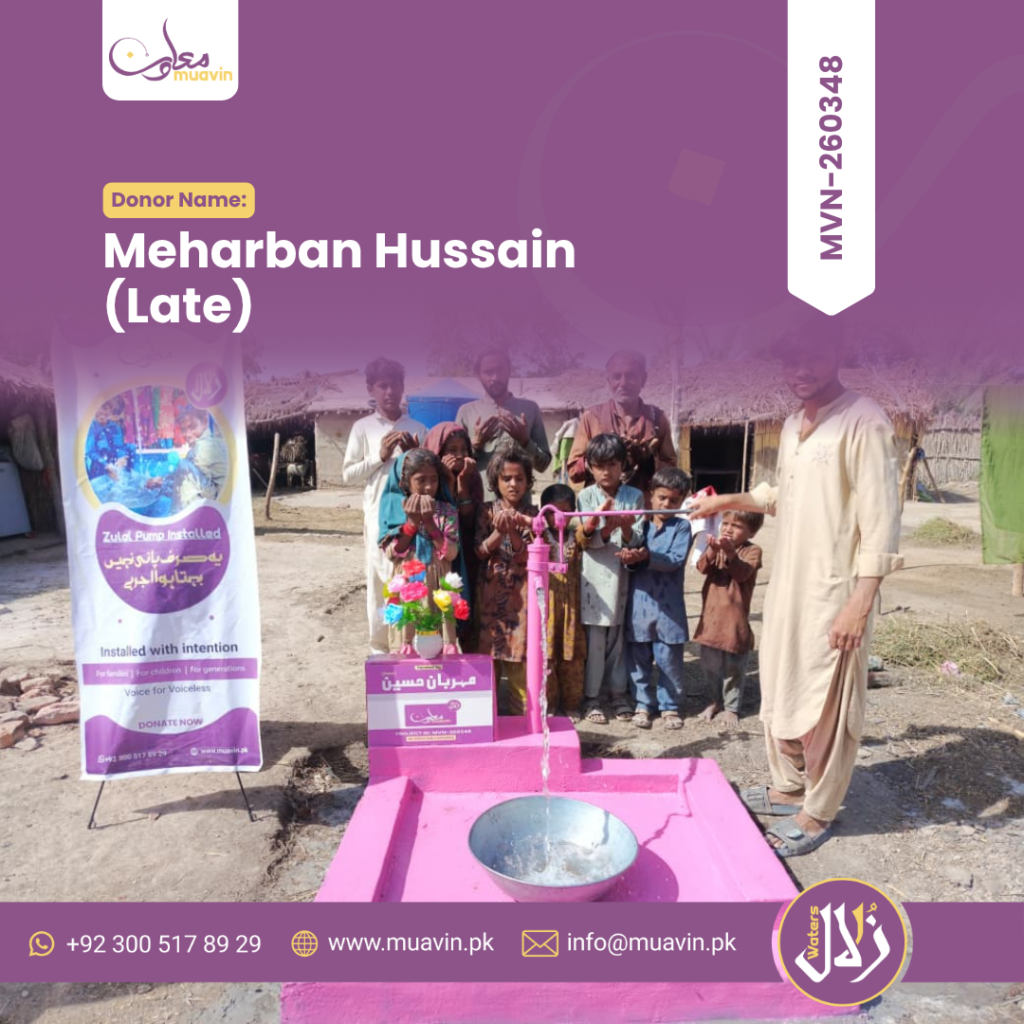
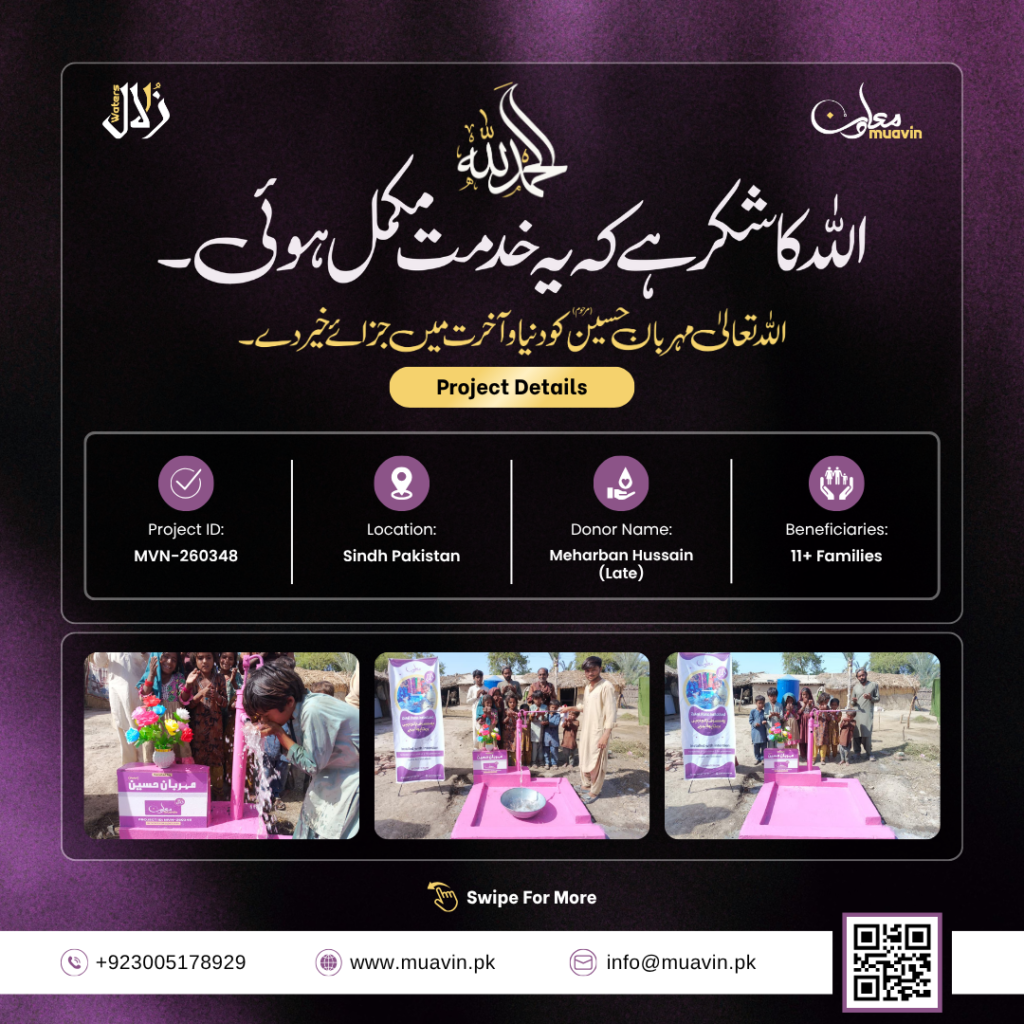
Yes. Many donors choose to dedicate a Sadqa Jariya water pump in someone’s name (Parent or Loved One) as a memorial, gift, or in celebration of life events.
We provide:
- A dedicated pump is capturing the name and message.
- Local installation records and a donor certificate showing the pump location and beneficiary community.
- Ongoing options for updates on the pump’s status (photo confirmation).
This form of Islamic charity water both honours a person and creates lasting community value through the Zakat water structure in Pakistan.
Is a donor’s p donation Zakatigible?
Donations intended as Sadqa Jariya are generally considered a form of sadaqah (voluntary charity) rather than zakat. However, in cases where a donor’s choice aligns with eligible zakat categories (for organizations that benefit people with low incomes directly and meet zakat criteria), some donors choose to apply zakat funds. We advise donors to consult their local religious advisor or the organization’s zakat policy to confirm eligibility.
How is the pump location selected?
Pump location selection follows a transparent, evidence-based process:
- Needs assessment: Field teams assess rural water indicators (distance to nearest safe source, reported illnesses, school/masjid needs).
- Hydrogeological survey: Verify groundwater suitability, including depth, yield, and quality tests.
- Community consultation: Water committees and local leaders confirm proposed sites and agree on governance and cost-sharing plans.
- Final approval: Selection is signed off on by program coordinators and local stakeholders before installation.
This collaborative approach ensures that each pump becomes an effective Sadqa Jariya and supports community ownership.
Do donors receive installation proof?
Yes. Donors typically receive:
- An installation certificate with the pump’s unique ID.
- Geo-tagged photos of the installed pump and the surrounding site.
- A brief report from the supervising field engineer confirming pump testing results and handover to the water committee.
These measures support transparency and help donors who wish to sponsor a clean water pump confirm real-world impact.
How much does a hand pump cost?
Costs vary by region, depth, and model, but a typical range covers:
- Low-cost shallow-well installations (simple hand pumps): Lower range
- Deep-set or corrosion-resistant models (for saline or deep water): Higher range.
Program budgets also include community training, spare-part pre-positioning, and monitoring costs to support sustainability.
For donors who want to donate a water hand pump in Pakistan, program staff can provide a detailed budget and financing options, including sponsorship from overseas donors in the UK and the USA.
How do communities maintain pumps?
Sustainable maintenance is a core program element:
- Establishing an on-ground community water project management committee/team with clear roles.
- Training local pump mechanics and caretakers.
- Setting up a modest spare-parts fund with transparent bookkeeping.
- Scheduling regular preventive maintenance and annual inspections from NGO field staff.
- Linking communities to local suppliers and workshops for parts fabrication.
These measures help ensure that a hand pump remains a continuous source of clean water and a meaningful Sadqa Jariya for years.
Can overseas donors sponsor pumps?
Yes. Overseas donors in the UK, USA, and elsewhere can sponsor one or multiple pumps. We offer:
- Donation processes compatible with local giving norms and tax considerations.
- Communication templates for dedications and gift sponsorships.
- Options for periodic updates and verified installation proof.
International donors play a vital role in addressing the rural Pakistan water crisis, supporting community water infrastructure in Pakistan initiatives that directly reduce the daily burden on women and children.
Community Transformation After Water Access
Clean, reliable water changes more than hydration to transform daily life, health, learning, and livelihoods. When a functioning hand pump is installed as Sadqa Jariya, the ripple effects can be immediate and build over time.
- Time savings: Women and children reclaim hours previously spent collecting water, which can be redirected toward education, income activities, and rest.
- Health and hygiene: Access to a nearby safe source reduces reliance on contaminated ponds or open wells.
- Education: Schools with onsite water solution see better attendance and participation, particularly among girls.
Conclusion
The rural Pakistan water crisis affects an estimated 21 million people, with women and children losing hours daily to fetch unsafe water. A single hand pump serves 50–200 people and can deliver lasting health education, nutrition, and economic gains when installed as Sadqa Jariya.
Investing in groundwater in Pakistan through sustainable Islamic charity water and community water infrastructure in Pakistan multiplies benefits for generations. If you can help, consider donating a water hand pump in Pakistan or supporting a Sadqa Jariya water project.