Across Pakistan’s rural heartlands, access to safe, reliable water is not a convenience. A daily struggle to shape health, education, and livelihoods.
For millions of families, the decision of where and how to collect water determines the rest of their day because time lost to queues or long walks, children pulled from school, and households exposed to contaminated supplies that can cause repeated illness.
Many Muslim donors are looking for meaningful Sadqa Jariya (a form of ongoing charity) that will produce lasting benefit. One of the most practical and spiritually resonant options is to support hand pump projects in Pakistan, a targeted way to provide sustained clean water and fulfill Islamic charity water principles in communities that need it most.
How One Hand Pump Changes Lives
Clean water scarcity in Pakistan is large-scale and persistent. Key facts make the crisis tangible:
- 21 million Pakistanis lack safe drinking water.
- One hand pump serves 50–200 people daily, depending on local demand and aquifer yield.
- Waterborne diseases are a major cause of child illness in rural areas.
- Women and children routinely spend hours each day collecting water, limiting education and income opportunities.
These figures show both the scale of need and the strong multiplier effect of a single intervention: a functioning hand pump can transform daily life for dozens of people every single day.
Groundwater access and hand pumps
In many parts of rural Pakistan, households rely on shallow groundwater or seasonal sources that are vulnerable to contamination and drying. Groundwater access is uneven: some villages sit above reliable aquifers, while others face depleted or saline groundwater that is unsafe to drink. Where the water table is accessible, a simple, well-maintained hand pump provides a direct, low-cost method to access water.
Why hand pumps are a practical choice:
- Simplicity: Hand pumps are mechanically straightforward and can be maintained by local technicians.
- Affordability: Installation and upkeep costs are lower than those of mechanized boreholes or piped networks.
- Scalability: Each hand pump typically serves between 50 and 200 people, making it possible to plan coverage across clusters of settlements.
- Sustainability: When combined with community management and periodic maintenance, hand pumps can deliver decades of service with an ideal form of Sadqa Jariya because benefits persist long after the initial gift.
A hand pump is not a universal solution, but compared with water trucking or temporary supplies, it provides continuous, community-controlled access. Water trucking gives immediate relief but requires ongoing funding. A properly installed hand pump can convert a one-off charity into a sustained daily service, which aligns with the concept of ongoing goodwill in Islamic charity.
How water scarcity affects life
The consequences of unreliable water reach into nearly every part of daily life in rural communities:
- Health: Contaminated water fuels diarrheal diseases, which are a leading cause of illness among children in rural Pakistan.
- Education: Girls in particular are often tasked with fetching water, which reduces school attendance and educational attainment.
- Economic opportunity: Time spent collecting water is time not spent farming, working, or taking part in income-generating activities.
- Community infrastructure: Without central water points, villages struggle to build effective sanitation and hygiene practices.
Typical daily burdens in affected villages include:
- Walks of 30 minutes to several hours to reach water points
- Long queues at unreliable sources, especially in dry seasons
- Recurrent medical costs and lost school days from waterborne illnesses
- The burden falls disproportionately on women and children
A modest infrastructure change, the installation and upkeep of a community hand pump, can meaningfully reduce these burdens.
Key terms and meanings
Understanding the language helps connect intent with impact:
- Sadqa Jariya: In Islamic belief, Sadqa Jariya is an ongoing charity whose benefits continue after the donor’s initial gift. Donations that fund sustainable water sources are a classic example.
- Islamic charity water: Charitable acts that provide safe water align with strong teachings in Islam about caring for community welfare and preserving life.
Before vs after basic water access
| Significant reduction over the months | Before reliable water access | After installation of a hand pump |
| Daily time spent fetching water | Several hours per household | Minutes; nearby access |
| Child school attendance | Frequent absenteeism | Increased regular attendance |
| Incidence of waterborne illness | High, recurrent | Significant reduction over months |
| Household economic activity | Severely limited | Improved productivity and income time |
These shifts illustrate why many philanthropists seeking a Sadqa Jariya water project choose to support modest community pumps: the benefits are immediate, measurable, and long-lasting.
How a hand pump project works
A hand pump project turns a one-time gift into ongoing relief. The mechanics are straightforward, but the social design matters. A pump installed at an accessible community point can connect people to safer groundwater, reduce exposure to contaminated sources, and return hours each day to women, children, and wage-earners.
For donors seeking Sadqa Jariya, a well-run hand pump becomes an enduring channel of benefit that continues to serve families long after the initial contribution.
Basic mechanics
- Survey: Local teams test groundwater access and water quality to identify sites where groundwater access is feasible and safe.
- Installation: A hand pump is set on a protected well or borehole and secured with a concrete apron and drainage to reduce contamination.
- Handover: The community receives training on daily use, simple repairs, and safe water handling.
- Maintenance plan: A local pump committee or trained technician carries out preventive maintenance and coordinates spare-part supply.
One hand pump serves 50–200 people daily, depending on village size and local demand. That scale means a single installation commonly supplies several households, schools, or a small health clinic, a compact but powerful Sadqa Jariya water pump project.
Site selection and community engagement
Choosing the right location for installation is as important. Nonprofit initiatives use a people-centered process to support sustainability:
- Needs assessment: Field teams meet village leaders and households to document water sources, seasonal shortages, and illness patterns.
- Hydrogeological check: Groundwater testing confirms yield and salinity levels to avoid drilling into unusable aquifers.
- Community agreement: Villages sign a simple memorandum of understanding that outlines roles for maintenance, protection, and equitable access.
- Inclusion measures: Projects prioritize schools, women’s groups, and vulnerable households to ensure benefits reach those most burdened by the rural water crisis.
Community buy-in reduces the risk of neglect and aligns the pump with Islamic charity water principles; the gift becomes theirs to care for, an essential feature of Sadqa Jariya.
Pump types and groundwater
Different hand pump designs suit different depths and water qualities. Nonprofits match pump options to local groundwater conditions as part of project delivery.
| Pump type | Typical depth range | Best use case |
| Standard hand pump | < 15 m | Villages with accessible shallow groundwater; low-cost, easy repairs |
| Deep-well manual pump | 15–60 m | Areas with deeper aquifers where higher yield is needed |
| Community multi-tap assembly | Variable | Serves larger clusters or schools/clinics; requires slightly more management |
Compared with large mechanized boreholes or piped networks, hand pumps are faster to deploy, cheaper to maintain locally, and more appropriate where community management capacity exists. Water trucking provides immediate but temporary relief and requires ongoing funding. A properly installed hand pump can convert a donor’s one-time Sadqa Jariya into daily service, aligning with both pragmatic impact and spiritual intention.
From donation to flowing water
Nonprofit partners translate donor intent into action through coordinated steps that prioritize safety, transparency, and sustainability. A typical implementation sequence:
| Training and governance | Benefit |
| 1 | Proposal and site vetting |
| 2 | Technical survey |
| 3 | Procurement and installation |
| 4 | Training and governance |
| 5 | Monitoring and maintenance |
Typical roles in a hand pump project:
- Local community: site maintenance, equitable access, small contribution to maintenance fund
- Field technicians: installation, technical training, spare parts supply
- Nonprofit partner: fundraising, project management, monitoring, and reporting
- Donor (Sadqa Jariya): provides funding for installation and initial capacity-building
These roles keep projects rooted in local ownership while supporting technical quality and accountability.
Long-term support and upkeep
Sustainability depends on clear ownership and simple, reliable maintenance systems. Successful projects typically combine:
- Training local pump caretakers and issuing a maintenance manual in local languages.
- Establishing a small community maintenance fund, often contributions equivalent to a few rupees per household per month, to buy bearings, seals, and handle larger repairs.
- Linking communities with municipal suppliers or NGO-run supply chains for spare parts.
- Periodic water quality checks to detect contamination and trigger remediation actions.
A well-governed hand pump is an effective form of community water infrastructure in Pakistan: it lives in the village, is cared for by villagers, and provides ongoing public health benefits consistent with Islamic charity water teachings.
| Noticeable reduction over the months | Before hand pump | After hand pump |
| Time fetching water | Hours per day | Minutes; local access |
| Child illness from waterborne disease | High, recurrent | Noticeable reduction over months |
| Female/child school attendance | Often reduced | Increases as water time drops |
| Local income time | Severely constrained | More time for farming/commerce |
These qualitative shifts explain why donors choose to support hand pump projects, such as Sadqa Jariya: the intervention is tangible, measurable, and enduring.
The role of nonprofits
Nonprofits act as the bridge between donor intent and reliable local impact. In hand pump projects, their role spans technical, social, and accountability tasks so that a Sadqa Jariya water pump becomes an enduring community asset rather than a short-lived donation.
- Technical oversight: Contracting hydrogeological surveys, choosing the right pump model, supervising skilled installation, and ensuring hygiene protections (concrete apron, drainage).
- Community facilitation: Convening village leaders, forming a pump committee, running training sessions for caretakers, and registering maintenance contribution agreements.
- Supply-chain management: Sourcing quality pumps and spare parts, and setting up local suppliers or rapid-response technicians for repairs.
- Monitoring and reporting: Recording installation proof (photos, GPS coordinates), tracking personnel performance, and producing donor reports that show use and impact over time.
- Coordination with local authorities: Linking community water infrastructure projects to municipal services when appropriate, avoiding duplication and ensuring sustainability.
These functions are especially important in the context of the rural Pakistan water crisis, where logistical challenges and varying groundwater access require local knowledge and trusted partnerships.
Accountability for donors
Donors often want both spiritual assurance (that this is valid Sadqa Jariya / Islamic charity water) and practical confirmation (that their money produced an installed pump). Reliable programs provide:
- A project agreement describing site selection criteria and community commitments.
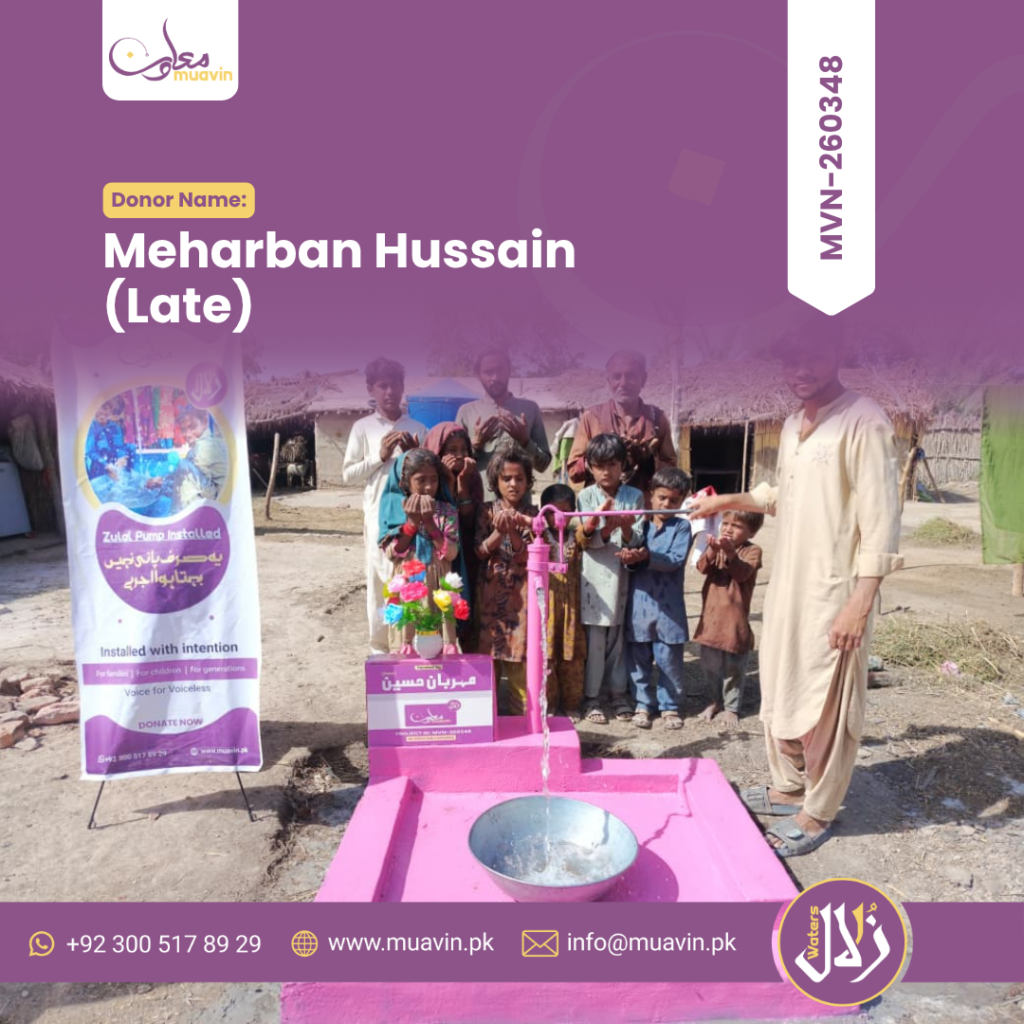
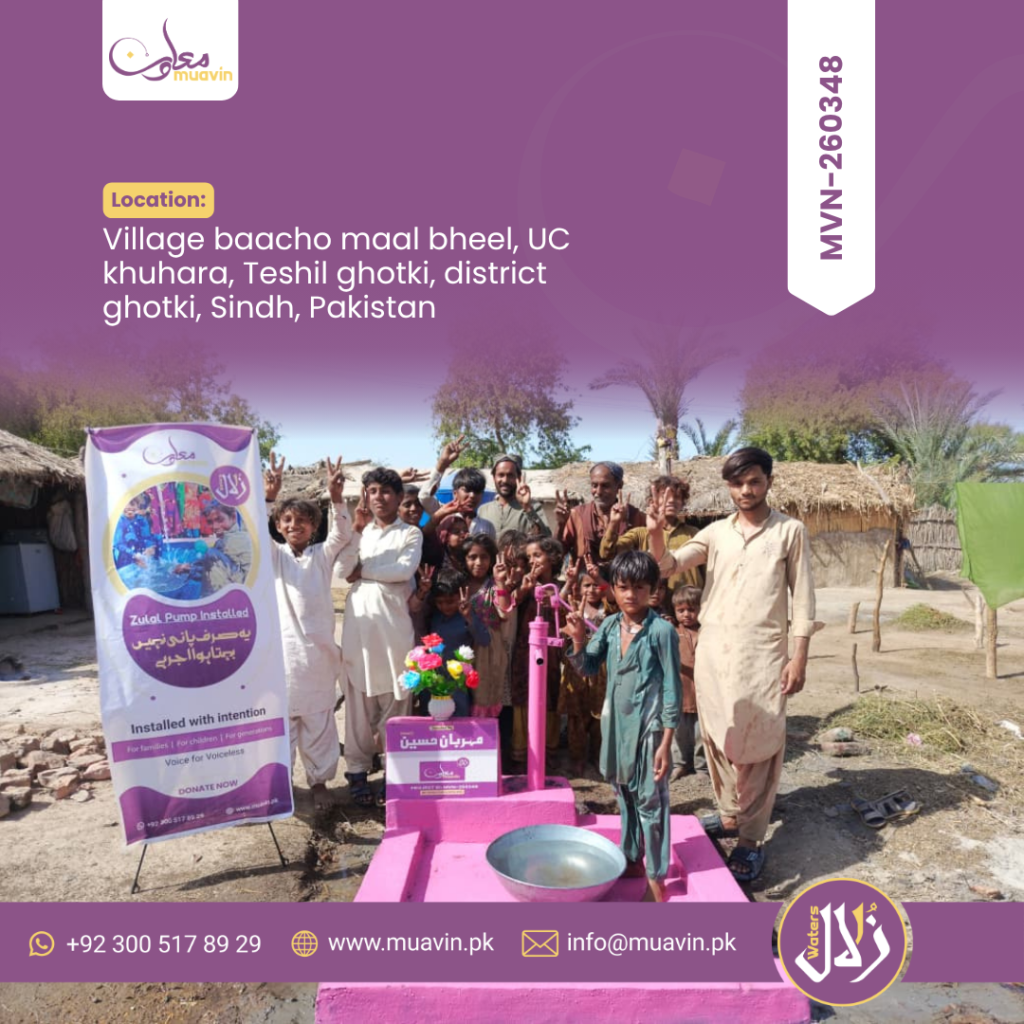
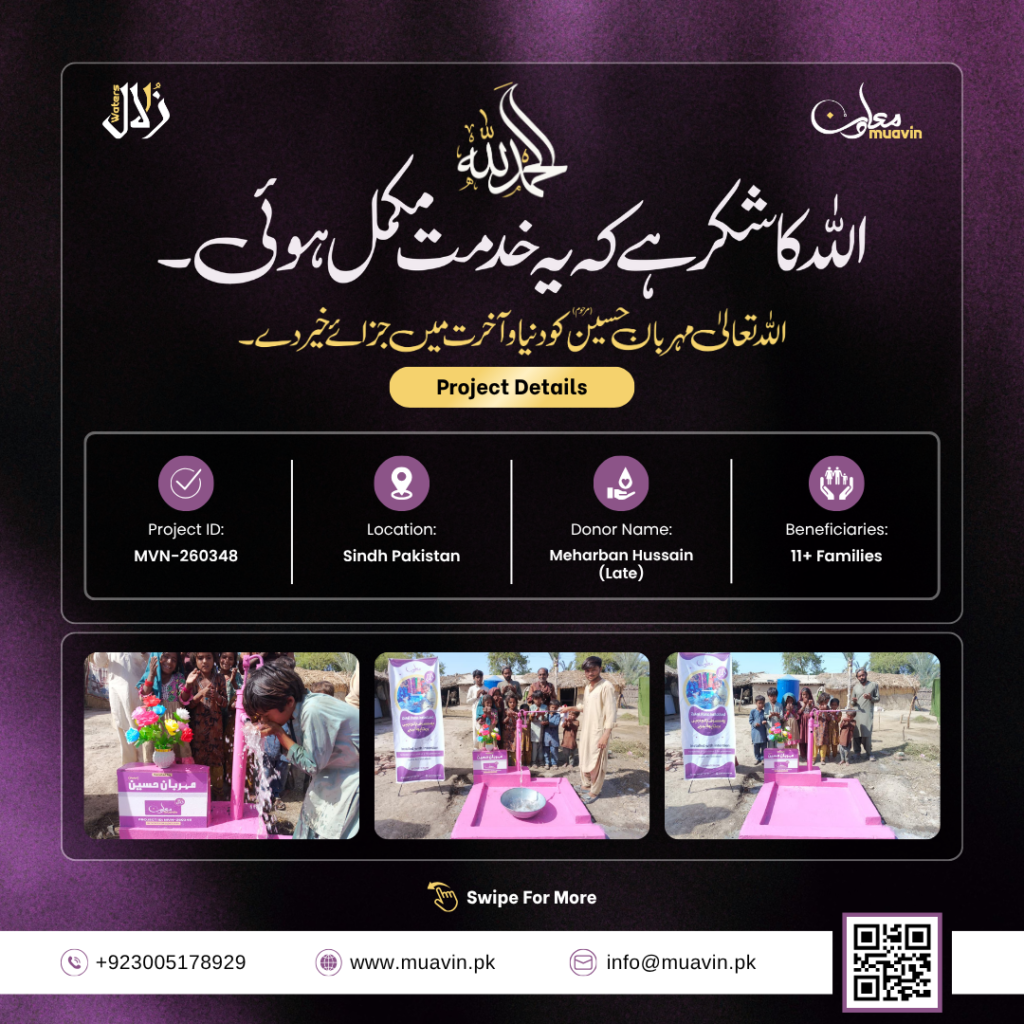
- Installation proof with installation date, photos, GPS coordinates, and a simple handover certificate signed by community leaders.
- Follow-up reports by monitoring visit summaries and maintenance logs for the first 12–24 months.
- Options for named or memorial donations with a charity-issued dedication certificate.
These measures help donors in Pakistan, the UK, and the USA feel confident that their support translates into functioning community water infrastructure that Pakistan needs.
If you are considering a heartfelt gift, read more about how to donate a hand pump in Pakistan as Sadqa Jariya.
Sadqa Jariya water pumps
Sadqa Jariya refers to an ongoing charity whose benefits continue after the donor’s initial gift. A Sadqa Jariya water pump is a physical embodiment. A hand pump was installed so that daily access to safer groundwater continues to benefit families, schools, Mosques, and clinics for years.
Key features of a Sadqa Jariya water pump project:
- Designed to provide recurring, reliable access to safer groundwater for an entire community.
- Paired with community agreements and caretaker training, so the pump remains usable long-term.
- Documented and dedicated with a certificate recognizing the donation as a long-term charity.
For many Muslim donors, choosing to donate a water hand pump in Pakistan is both a practical humanitarian act and a spiritually meaningful Sadqa Jariya.
How many people use one pump?
A single hand pump typically serves 50–200 people daily, depending on village size and proximity to other water sources. In some settings, one pump will supply a small cluster of households; in others, it may serve a school or health clinic as well.
How long does a hand pump last?
With proper installation, correct siting, and routine maintenance, a hand pump can function for 10–20 years or more. Longevity depends on:
- Pump quality and suitability for the local depth.
- Preventive maintenance (lubrication, seal replacement).
- Timely access to spare parts and trained technicians.
- Community governance and a small maintenance fund to cover repairs.
| Pump type | Typical lifespan | Regular maintenance |
| Family hand pump | 10–20 years | Annual bearing/seal checks, local repairs |
| Deep-well manual pump | 10–15 years | More frequent seal replacement, occasional component replacement |
| Solar-assisted borehole pump (community systems) | 8–20 years (components vary) | Battery/solar maintenance, motor servicing, occasional pipework |
Lifespan estimates assume correct siting on viable groundwater, quality installation, and an active maintenance plan. In regions with harder water or heavy use, certain components may need replacement sooner.
Can I donate a pump in someone’s name?
Yes. Many donors choose to make a hand pump donation to Pakistan in memory of a loved one or as a named Sadqa Jariya gift. Programs typically offer:
- A dedication certificate that records the donor name, honouree, and date.
- Installation proof (photos and GPS coordinates) tied to the donation record.
- Optional updates or an anniversary report showing ongoing usage.
If you would like to sponsor a clean water pump in someone’s name, specify dedication details at the time of donation so the project team can prepare the certificate and record.
Is a water pump donation Zakat eligible?
Water projects that provide essential, life-sustaining services such as safe drinking water are commonly considered eligible for Zakat, especially when the donation benefits poor and vulnerable communities long-term as Sadqa Jariya. Donors in Pakistan, the UK, and the USA often seek guidance from their own scholars or the charity’s Zakat policy; reputable charities will:
- Publish a Zakat eligibility statement for specific projects.
- Allow donors to designate funds as Zakat and provide a receipt that documents the donation purpose.
This alignment with Islamic charity water principles makes hand pump donations attractive to faith-based donors looking to support ongoing impact.
Do donors receive installation proof?
Yes. Accountability measures generally include a combination of:
- Dated installation photos and video.
- GPS coordinates and a handover certificate signed by community representatives.
- A brief monitoring report after 6–12 months describing pump performance and any repairs.
These practices reflect sector standards used by organisations across the humanitarian ecosystem (for example, Charity Water, WaterAid, and Islamic Help), and they help donors verify real-world results when they choose to donate a
Conclusion
Over 21 million Pakistanis lack safe drinking water, and people in rural areas in Pakistan lose hours collecting unsafe water. A single hand pump can serve 50–200 people daily, turning Sadqa Jariya into lasting life support by improving groundwater access and strengthening community water infrastructure in Pakistan.
Choose a sustainable charity that supports maintenance, community ownership, and monitoring, and take meaningful action today.