Millions of families across rural Pakistan wake each day without reliable access to clean drinking water. For households scattered across remote villages, the nearest safe water source can be several kilometers away. This daily burden falls disproportionately on women and children.
When you donate water pump equipment or sponsor a hand pump, you are helping to restore dignity, health, and hope to communities living on the front lines of a water crisis.
The Water Crisis in Rural Pakistan
Rural Pakistan faces a layered water emergency. Groundwater depletion, contamination of surface sources, and lack of infrastructure mean that many communities rely on unsafe wells, seasonal ponds, or distant communal taps. The result is that many families depend on sources that can transmit waterborne illnesses or require dangerous, time-consuming collection.
Key human impacts:
- Women and children often walk several kilometers daily to collect water, losing hours that could be spent on education, income, or rest.
- Waterborne diseases remain a major cause of illness, affecting children’s growth and community productivity.
- One family hand pump can provide clean water for 20 to 30 people, including nearby homes and animals, transforming multiple lives with a single sustainable intervention.
Clean Water Terms and Definitions
Understanding key terms helps clarify how a single intervention fits into a larger solution.
- Clean Drinking Water: Water free from pathogens and dangerous contaminants, safe for daily consumption without treatment.
- Groundwater: Water stored beneath the earth’s surface; a common source for wells and hand pumps in rural Pakistan.
- Hand Water Pump (hand pump): A manually operated pump fitted to a borehole or shallow well to draw groundwater for household use.
- Community Water Access: Shared or communal systems (wells, hand pumps, small piped networks) that provide water to multiple households.
- Sadaqah Jariyah: A form of continuous charity in Islam; providing lasting resources like a water pump is a recognized way to earn ongoing spiritual reward.
- Sustainable Charity: Interventions designed for long-term benefits, minimal maintenance, and community ownership.
- Clean Water: The United Nations’ Sustainable Development Goal aims for clean water and sanitation for all.
When donors choose a water pump as a sadaqah jariyah gift or through secular sponsorship programs, they invest in long-term community resilience rather than a one-off aid delivery.
Daily Life Without Safe Water
Water scarcity and contamination ripple through every part of rural life. The absence of accessible clean water affects health, education, gender equity, economic opportunity, and animal care.
Every day consequences include:
- Lost school days for children who must fetch water.
- Increased illness and healthcare costs from waterborne diseases.
- Time poverty for women limits participation in paid work or community leadership.
- Reduced livestock health, affecting household nutrition and livelihoods.
Walking for water vs. a local hand pump:
| Aspect | Walking for water | Local hand pump |
|---|---|---|
| Time and effort | Multiple trips daily; significant time loss | Immediate access near homes |
| Safety and health | Exposure to unsafe sources; higher disease risk | Safer groundwater after appropriate testing and installation; reduced disease rates |
| Daily opportunities | Less time for education and work | Reclaimed time for education and work |
This comparison shows how installing a single hand water pump can shift daily life from survival-focused chores to opportunities for growth and learning.
Who Benefits From a Hand Pump
The benefits extend beyond the immediate household to a wider community network. A single hand pump installed at a central point often serves neighboring homes and livestock, multiplying its impact.
Typical beneficiaries:
- 20–30 people per family hand pump (including nearby households and animals)
- Children who gain more consistent school attendance
- Women who regain hours each day for education, income, or rest
- Entire villages through reduced disease transmission and improved hygiene
Before vs. after local water access:
| Metric | Before (no local pump) | After (hand pump installed) |
|---|---|---|
| Daily distance to fetch water | Several kilometers | 0–500 meters |
| People served per source | Unreliable, limited | 20–30 per hand pump |
| Waterborne illness rates | Higher | Significantly reduced |
| Time available for school/work | Low | Increased |
This table shows measurable changes in time use, health, and community reach when a hand pump is introduced.
Why Hand Pumps Support Sustainability
Hand water pumps are often chosen because they balance cost, durability, and community control. Unlike large, complex systems that require continual external support, a well-installed hand pump taps groundwater and delivers clean drinking water with low energy needs and relatively simple maintenance.
Key sustainability features:
- Low energy footprint: Manual operation requires no electricity or fuel.
- Local repairability: Spare parts and basic tools are commonly available in district markets.
- Community ownership: Villagers can form committees to manage usage and repairs.
- Scalability: Each pump typically serves 20–30 people, so multiple pumps can be deployed to reach larger populations.
- Alignment with Clean Water: Hand pumps are practical steps toward universal, equitable access to safe water.
These characteristics make hand pumps a strong match for sustainable charity models in rural Pakistan. When donors choose to support water pump equipment, they help establish an asset that continues to deliver clean water long after the initial installation.
How Hand Pump Projects Work
Delivering clean drinking water via hand pumps involves coordinated technical work, community participation, and ongoing maintenance. Below is a step-by-step overview of how nonprofit programs translate donations into safe, accessible water.
Assessment and site selection
Before any drilling or installation begins, field teams complete a careful assessment:
- Survey the village to map current water sources, distances walked, and population clusters.
- Conduct community meetings to identify the most suitable, secure pump location.
- Perform hydrogeological surveys or consult local water tables to confirm groundwater availability.
This upfront work reduces the risk of failed wells and helps ensure one hand pump serves the largest possible number of households.
Drilling, installation, and quality checks
Once a site is confirmed, technicians begin the technical phase:
- Borehole drilling to the appropriate depth based on groundwater data.
- Installation of casing and a reliable, locally appropriate hand pump model.
- Sanitary sealing to prevent surface contamination of groundwater.
- Water testing for microbes and common contaminants; treatment or alternative siting if tests fail.
Because groundwater quality varies across regions, technical teams follow national standards and field protocols to confirm the water is safe for drinking.
Community training and maintenance
Sustainability depends on local capacity:
- Establish a water committee from village members (often including women) to manage day-to-day use and fee collection for spare parts.
- Train selected technicians on routine maintenance, simple repairs, and part replacement.
- Provide a maintenance kit with common spare parts and a manual in the local language.
Communities that manage their own pumps often keep them functional longer, protecting donor investment and supporting continuous Sadaqah Jariyah benefits.
Monitoring and follow-up
Nonprofits typically schedule periodic monitoring visits:
- Check water quality seasonally.
- Verify pump functionality and resolve mechanical issues.
- Gather usage data and health indicators to measure long-term impact.
This combination of technical rigor and local stewardship is what turns a donated hand pump into a lasting community resource.
Community Support and Delivery
Nonprofit water programs are designed to be collaborative, culturally sensitive, and locally led. The support pathway usually looks like this:
- Outreach and education: Field teams meet with local leaders to explain project goals, responsibilities, and benefits.
- Joint planning: Communities agree on site selection, contributions (labor, land, and small administration fees), and governance structures.
- Implementation: Local labor is often hired for non-specialized tasks, creating short-term local employment.
- Handover: After installation and initial training, the community formally accepts the pump and water committee management.
Benefits of this model include stronger local buy-in, quicker repairs, and the cultural legitimacy that comes from community-led solutions. This approach also resonates with Muslim donors interested in Sadaqah Jariyah; when you support a water pump project, you are funding an intervention that community members steward and sustain.
External aid vs. community-led installation:
| Model | What it looks like |
|---|---|
| External aid model | Large contractors install systems with limited local input; repairs rely on external teams. |
| Community-led model | Local people participate in planning and maintenance; ownership increases sustainability and social cohesion. |
Types of water pumps for rural Pakistan:
| Pump Type | Typical use | Pros | Cons |
|---|---|---|---|
| Hand Water Pump | Household & small community | Low cost, locally repairable, no power needed | Manual effort, limited flow |
| Solar-Powered Pump | Larger community or piped scheme | Higher flow, low ongoing fuel cost | Higher initial cost, requires spare part supply |
| Motorized Borehole Pump | School/clinic/large village distribution | Can serve piped systems | Needs electricity/fuel and technical upkeep |
This comparison can help donors and program planners decide whether to support hand pump installations or consider complementary options for larger settlements.
Implementation Timeline and Steps
Turning plans into reality in rural Pakistan requires coordination across technical, social, and logistical needs. A typical timeline includes:
| Phase | Typical timeframe | What happens |
|---|---|---|
| Pre-assessment | 1–2 weeks | Surveys, community meetings, hydrogeological mapping |
| Drilling and installation | 2–4 weeks | Borehole work, pump fitting, initial testing |
| Training and handover | 1 week | Community workshops, delivery of maintenance kits |
| Monitoring phase | Ongoing | Scheduled visits at 3, 6, and 12 months, then annually |
During implementation, nonprofits handle procurement, skilled drilling teams, quality assurance, and logistics. They also source parts that are locally available to support long-term repairs. Field coordinators manage relationships with village leaders, schedule work to avoid disrupting daily activities, and document each stage for donor transparency.
- Local crews are contracted for excavation, site clearance, and non-specialized tasks, creating short-term employment.
- Skilled drillers and pump fitters perform the technical work, following the pre-approved design and sanitary protocols.
- A final commissioning step includes water testing, community acceptance, and handover documentation.
After handover, ongoing monitoring focuses on pump uptime, usage patterns, and basic water quality checks. The goal is to keep the pump delivering clean drinking water and contributing to Clean Water over the long term.
Program Costs and Donor Options
Understanding how much it costs to donate a water pump in Pakistan and the options available helps donors match their giving to impact goals. Whether they want to support a single-family pump, sponsor multiple installations, or contribute to a wider community water access program.
How much does it cost to donate a water pump in Pakistan?
Costs vary by region and pump type, but a typical breakdown for a rural family hand pump installation includes:
- Site assessment and hydrogeological check: modest field fees
- Drilling and borehole casing: varies with depth and geology
- Hand pump unit and sanitary sealing: cost of pump plus installation labor
- Training, maintenance kit, and initial follow-up: spare parts and training materials
Short cost guide (indicative):
| Item | Typical range (USD) |
|---|---|
| Assessment & site work | $10–$50 |
| Drilling & casing | $40–$70 |
| Hand pump unit & installation | $80–$120 |
| Training & maintenance kit | $20–$40 |
| Total typical cost (family hand pump) | $150–$280 |
Note: Prices vary with depth to groundwater, transport logistics in rural Pakistan, and seasonal access. Donors interested in larger systems (solar or motorized pumps) will see higher ranges.
Is donating water a form of Sadaqah Jariyah?
Yes. In Islamic tradition, gifting a sustainable water source is widely recognized as sadaqah jariyahan, with an ongoing charity that continues to benefit people after the initial act of giving.
- A hand pump providing clean drinking water to a village becomes a continuous source of reward as long as people use it.
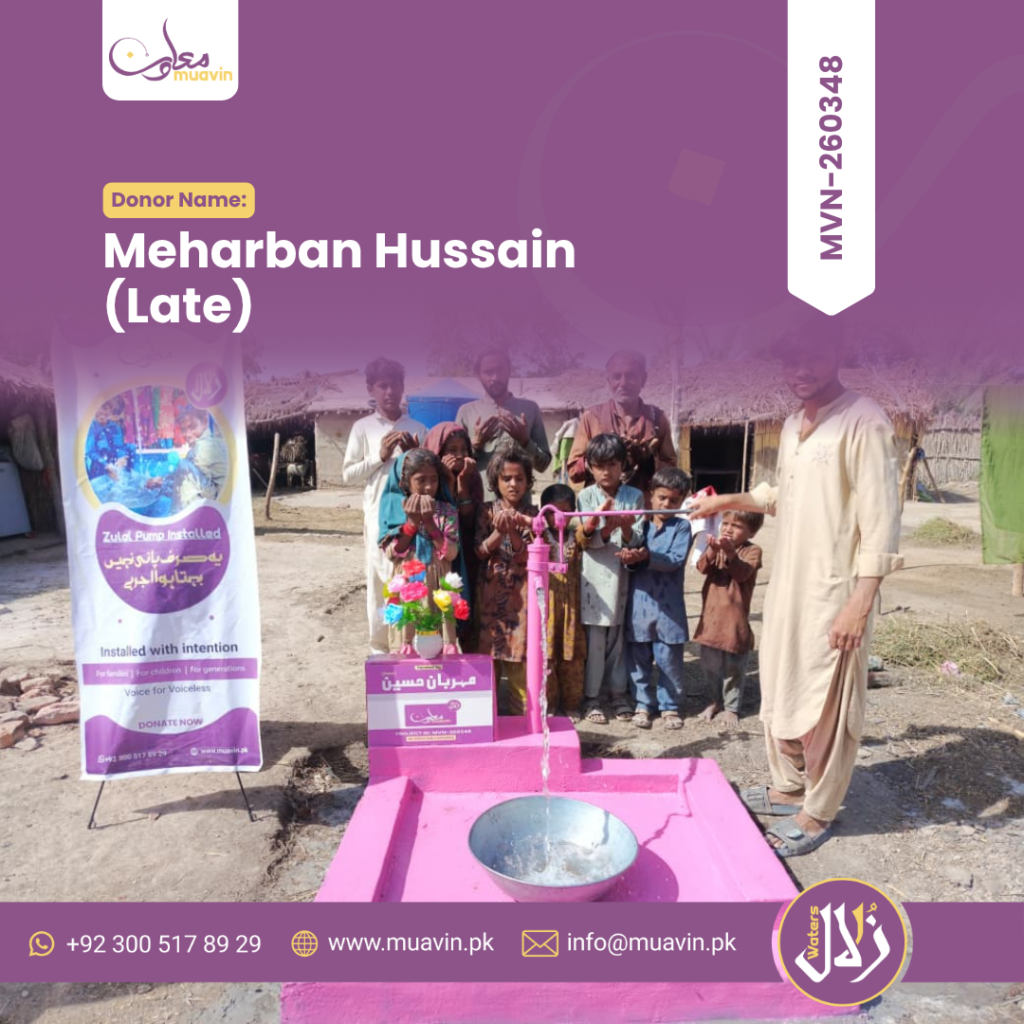
- Many donors choose to dedicate a pump in memory of a loved one or as an ongoing charity for their family.
Programs typically document dedications and can offer wording suitable for religious contexts for donor records.
Can I donate a water pump in someone’s name?
Yes. Most organizations permit donors to sponsor a pump in a loved one’s name, for occasions like weddings, memorials, or Ramadan projects.
- Dedication options: individual pump, cluster of pumps, or contribution toward a community scheme.
- Donors usually receive a certificate or acknowledgment (see “Do donors receive proof of installation” below).
This option aligns well with faith-driven giving and with secular memorial giving.
How many people benefit from a family hand pump?
A single-family hand pump typically serves 20 to 30 people. This can include nearby households and domestic animals.
- Benefit profile:
- Households within walking distance gain direct access.
- Women and children save hours previously spent collecting water.
- Nearby livestock access reduces contamination of household sources.
How long does a water pump last in rural areas?
Lifespan depends on quality, usage, maintenance, and groundwater conditions:
- Typical operational life for a well-installed, locally maintained hand pump: 5–15 years.
- Longevity factors:
- Regular maintenance and availability of spare parts.
- Sand and sediment levels in groundwater.
- Frequency of use and mechanical wear.
Training local technicians and supplying spare parts can significantly extend service life as an important part of sustainable charity design.
Do donors receive proof of installation?
Most reputable programs provide documentation to assure donors that their contribution has turned into a tangible impact:
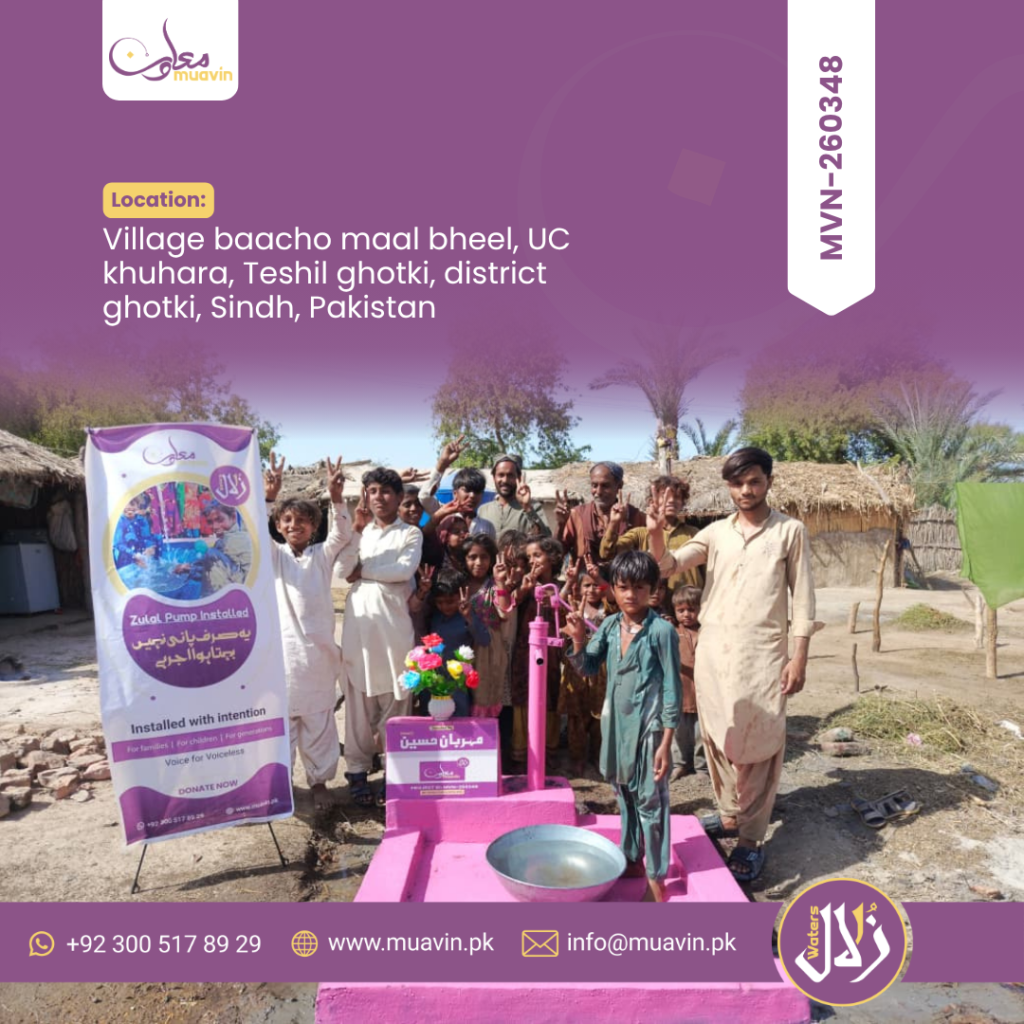
- Installation report with photos and GPS coordinates.
- Certificate of dedication (if requested).
- Periodic monitoring updates summarizing pump health and community use.
These records support donor reporting and provide evidence for faith-based registry needs or organizational transparency.
Why is water charity important in Pakistan?
Water charity addresses multiple, interconnected needs:
- Scale: Millions in rural Pakistan lack safe drinking water and rely on unsafe sources.
- Health: Access to clean water significantly reduces waterborne diseases and improves daily life.
- Education and livelihoods: Women and children who no longer walk long distances can pursue education and income-generating activities.
- Gender equity: Reducing daily water collection burdens disproportionately benefits women and girls.
Community Transformation After Water Access
When a functioning hand water pump is installed in a village, the change is immediate and visible. Clean drinking water close to homes alters daily routines, frees up time, and reduces health risks. These effects can cascade through families and the wider community.
Households experience concrete shifts in daily life:
- Women and children reclaim hours previously spent walking to distant sources, enabling schooling and small enterprises.
- Incidence of waterborne sickness declines as households access safer groundwater rather than surface or contaminated wells.
- Livestock and small gardens benefit from nearby water, which supports livelihoods and nutrition.
Impact statistics:
- Millions in rural Pakistan lack safe drinking water and rely on unsafe sources.
- Women and children often walk several kilometers daily to collect water.
- One family hand pump can provide clean water for 20 to 30 people, including nearby homes and animals.
- Access to clean water significantly reduces waterborne diseases and improves daily life.
Before vs. after water access:
| Metric | Before pump | After pump |
|---|---|---|
| Daily time fetching water per household | 2–5 hours | 10–30 minutes |
| People served by nearest source | Variable, often overcrowded | 20–30 per family pump |
| Reported waterborne illness (relative) | High | Noticeably reduced |
| School attendance for children (esp. girls) | Lower due to collection duties | Improved |
This transformation also supports broader community water access goals. When several family pumps are installed across neighbouring hamlets, the network effect can multiply benefits across a cluster, reducing pressure on contaminated sources and enabling community-level improvements in sanitation and hygiene.
If you want to help this kind of change directly, you can choose to donate a water hand pump in Pakistan through trusted programs that document installation and follow-up care.
Long-Term Sustainability of Water Projects
Durable impact depends on choices made before, during, and after installation. Sustainable charity design balances appropriate technology, community ownership, and access to spare parts.
Key sustainability elements include:
- Selecting the right pump type for local groundwater conditions and usage patterns.
- Training local technicians and establishing a spare-parts supply chain.
- Forming village water committees responsible for simple repairs, hygiene promotion, and record-keeping.
- Monitoring pump uptime and usage to address problems early.
Maintenance models and local ownership
Successful projects shift responsibility to communities gradually, with ongoing NGO support during the handover period. Common models include:
- Community-managed funds (small, regular contributions used for parts and labor).
- Local entrepreneur models (a trained mechanic sells services and parts locally).
- Hybrid support where NGOs guarantee periodic technical assessments while communities handle day-to-day maintenance.
These approaches can increase pump lifetime, moving the likely operational window from a fragile 1–3 years to a more sustainable 5–15 years for well-installed hand pumps.
Technical choices for pump systems
Choosing technology involves trade-offs between cost, complexity, and expected demand.
| Feature | Family Hand Pump | Solar/motorized pump |
|---|---|---|
| Typical cost | Low–moderate | High |
| Technical complexity | Low | High |
| Maintenance needs | Local spare parts & basic skills | Skilled technicians & fuel/solar upkeep |
| Number of beneficiaries | 20–30 per pump | Hundreds to whole village |
| Suitability in rural Pakistan | Very suitable for shallow groundwater | Suited to community schemes or irrigation |
A family hand pump is often the most appropriate first step in remote hamlets: affordable, repairable locally, and well-suited to serving 20–30 people. Solar or motorized pumps are better where demand, groundwater depth, and community management capacity justify higher upfront and ongoing costs.
Programs that sponsor water pumps in Pakistan typically evaluate these variables during site assessment, ensuring the chosen technology aligns with local hydrogeology and social structures.
Transparency and Accountability
Donors often want assurance that their gift becomes tangible, long-lasting, clean drinking water. Transparency and independent oversight help build trust between donors, implementers, and communities.
Common transparency measures:
- Detailed installation reports with photos, GPS coordinates, and beneficiary lists.
- Certificates of dedication for donors contributing sadaqah jariyah, water pump gifts, or memorial projects.
- Periodic monitoring reports showing pump uptime, usage trends, and any repairs.
- Third-party audits or partner verification for larger community systems.
How donors verify impact:
- Review installation documentation and GPS-tagged photos that confirm the pump’s existence and location.
- Follow monitoring updates that report uptime percentages and the number of households served.
- Request copies of community handover records and any training register for local mechanics.
Organizations across the humanitarian ecosystem—ranging from local NGOs to international actors such as Charity Water, WaterAid, ID, and Islamic Help—use similar accountability practices to maintain donor confidence. Choosing programs with clear monitoring protocols helps reduce the risk of wasted funds and strengthens sustainable charity outcomes.
Conclusion
Millions in rural Pakistan still lack safe drinking water, forcing women and children to walk miles and families to rely on unsafe sources. A single hand water pump can serve 20–30 people and catalyze lasting change when paired with community training and spare-parts plans. By choosing sustainable charity and Sadaqah Jariyah gifts, you advance Clean Water and transform lives to consider donating a water hand pump in Pakistan supporting a Sadqa Jariya water project today.
Frequently Asked Questions
How many people use one pump?
One family hand pump typically serves 20–30 people, including nearby homes and animals. Usage varies by household size and local demand.
Can I donate a pump in someone’s name?
Yes. Many programs accept dedicated donations and issue certificates or donor reports to honour the recipient or memorial.
How long does a hand pump last?
With proper sit-in installation and maintenance, a hand pump can operate reliably for 5–15 years. Local spare parts and training extend the lifetime.
Is donating a pump considered Sadaqah Jariyah?
Yes. Funding a sustainable water source that benefits people over time is commonly accepted as Sadaqah Jariyah in Islamic giving traditions.
What is included in a pump donation?
Typical packages include site assessment, well drilling or hand pump installation, basic training, and initial spare parts. Details depend on the implementing NGO.
How do organizations choose pump locations?
NGOs perform community needs assessments, hydrogeological surveys, and consult local leaders to ensure groundwater availability and social readiness.
Can I sponsor a pump remotely?
Yes. Many charities allow remote sponsorship and provide documentation, photos, and monitoring reports to verify installation and impact.
How can I verify my donation reached the community?
Look for installation reports with photos, GPS coordinates, beneficiary lists, ts, and follow‑up monitoring updates from the implementing organization.
What if groundwater is too deep for a hand pump?
If groundwater exceeds hand‑pump depth, programs evaluate alternatives such as motorized or solar pumps and may recommend community systems instead.
How are spare parts supplied locally?
Effective programs establish local supply chains or train entrepreneurs to stock and sell common parts to ensure quick repairs and reduced downtime.
What accountability measures exist?
Reputable charities use GPS‑tagged photos, periodic monitoring reports, community handover records, and third‑party audits for transparency.
How much training is provided locally?
Programs commonly offer basic repair training for local technicians and hygiene promotion for water committees to ensure sustainable operation.
Can I fund multiple pumps in one area?
Yes. Donors can support cluster approaches to multiply impact, relieve pressure on contaminated sources, and boost community water access.
Will a pump improve health and education?
Access to nearby clean water typically reduces exposure to unsafe sources and frees time for school and work, contributing to overall wellbeing.
How are beneficiaries selected?
Communities, local leaders,s and NGOs collaborate to prioritize households with the greatest need, aiming for equitable access and social inclusion.
Can I combine a pump donation with sanitation work?
Yes. Integrating water, sanitation,n and hygiene interventions enhances impact and supports long‑term health and dignity outcomes.
How do I start a Sadqa Jariya water project?
Contact a trusted clean water charity, discuss site assessments, agree on monitoring, plans, and specify how you want the project dedicated or reported.
What documentation will I receive?
Expect installation certificates, photos, GPS data, beneficiary lists, and periodic uptime or monitoring reports documenting impact.